
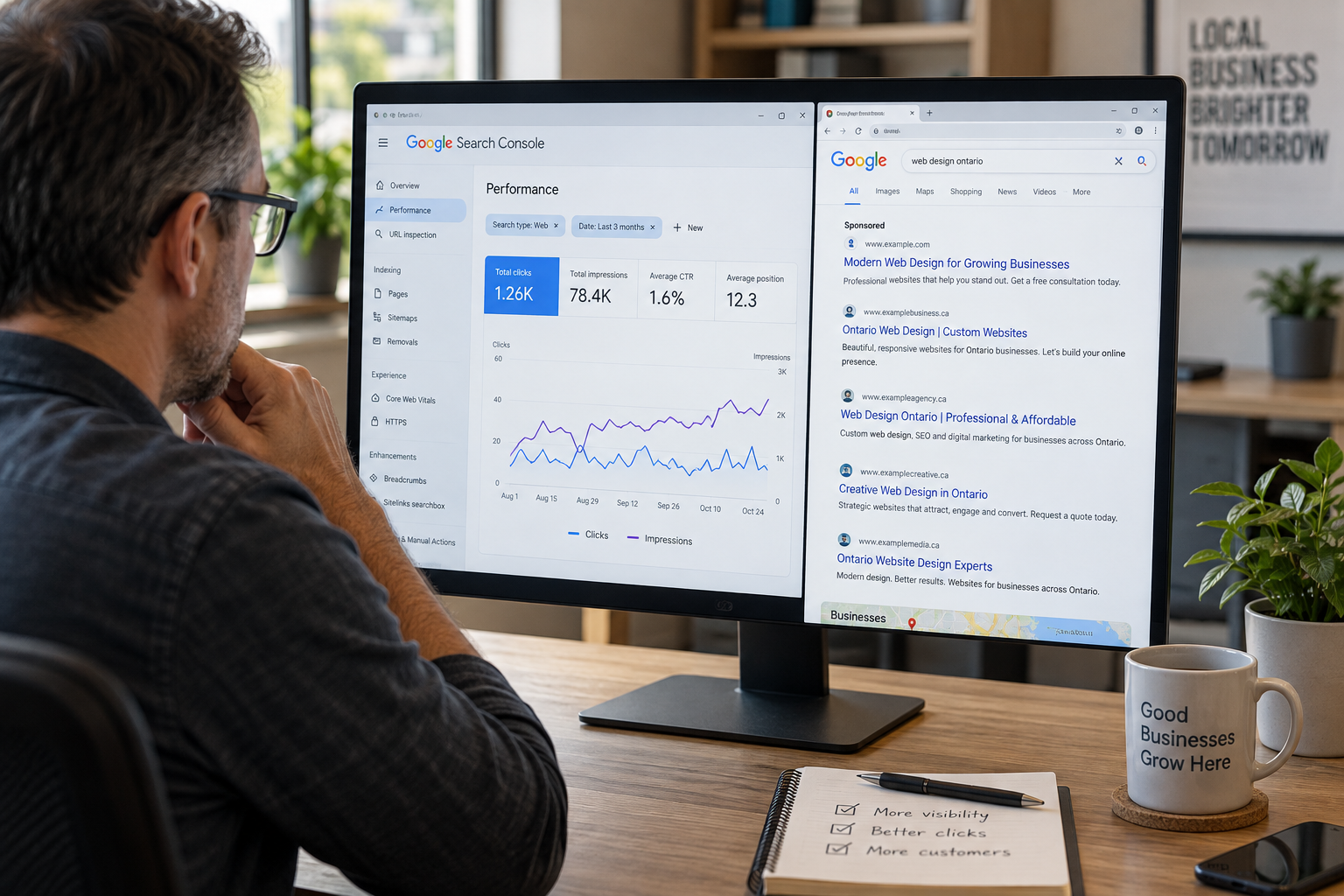
Search Console shows thousands of impressions. Your rankings have improved, and your business is appearing for searches related to the services you provide. But the clicks and inquiries are not following.
That does not necessarily mean your SEO is failing. It means ranking is only one part of the process. Effective search engine optimization should create qualified visibility that has a realistic opportunity to contribute to business results.
The sequence is simple: appear, earn attention, earn the click, earn trust, and earn the inquiry. A problem at any point can weaken the final business result.
Being Seen and Being Chosen Are Two Different Things
Search visibility creates an opportunity. It does not guarantee that someone will choose your result.
A customer searching Google may see your business alongside competitors, directories, Maps results, ads, review sites, larger brands, and other sources of information. Before that person ever reaches your website, they are already deciding which result deserves attention.
That distinction matters when a website is ranking but getting few clicks. The first question should not automatically be, “What’s wrong with our title?” You first need to understand where and why the website is appearing.
First, Make Sure You’re Ranking Where People Actually Click
An impression does not mean your website appeared prominently. It indicates that a search result containing your site was shown, but that visibility can occur at very different positions.
A business appearing around position 22, for example, can accumulate substantial impressions without receiving meaningful organic search traffic. There is an important practical difference between appearing in the top three, elsewhere on page one, near the bottom of page one, and on page two or beyond.
For a business competing for SEO in Kitchener, moving from deeper search results toward page one can still represent an important commercial opportunity. The business may already have some search visibility, but stronger positioning can put it in front of more customers when they are actively comparing providers.
High impressions combined with low clicks do not automatically indicate a broken search listing. Position still matters.
Then Ask Whether You’re Ranking for the Right Search
More visibility is not always more useful visibility.
A website can accumulate impressions from informational searches, broad questions, research-oriented queries, irrelevant geographic areas, or topics only loosely connected to what the business actually sells. Those numbers can make an SEO report look active without necessarily representing potential customers.
The more useful question is whether your visibility is occurring for searches that matter to the business. Are potential customers seeing the pages that match the services you want to sell? Are those searches coming from relevant markets? Does the intent behind the search suggest someone could realistically become a customer?
Google impressions but no clicks can therefore be a relevance issue as much as a ranking issue.
Your Search Result Is Competing Before Your Website Ever Gets a Chance
Even when you rank for the right search, the customer still has options.
Your result may appear beside several agencies, directories, Maps listings, advertisements, review platforms, larger brands, and AI-generated information. The searcher can evaluate many of those options without visiting your website.
Your page title, search snippet, recognizable location, service specificity, brand familiarity, and reputation can all influence whether someone gives your result further consideration. In local search, reviews and accurate business information can also shape that decision, making Google Business Profile optimization part of the broader search visibility picture.
This does not mean every case of low organic CTR can be fixed by rewriting a title or description. It means the search result itself is part of the customer’s decision-making process.
“Professional Web Design” Doesn’t Give Anyone a Reason to Choose You
Competitive service searches often expose another problem: businesses can sound almost identical.
If five companies all promise professional service, affordable pricing, quality work, experienced teams, and customized solutions, those claims provide very little help to someone trying to choose between them.
Consider a customer searching for website design in Burlington. Several businesses may be relevant and visible. If each one appears to offer essentially the same service with the same broad promises, SEO has succeeded in creating visibility but positioning has not necessarily created preference.
Your search result does not need to contain your entire sales pitch. It does need to give the right customer a reason to believe your business is relevant to what they need.
Local Searches Create a Different Kind of Competition
Local commercial searches make this choice problem especially clear.
Someone searching for SEO in Oakville is not simply asking whether anyone can provide SEO services. They may be looking at several credible businesses that all claim they can help.
The competition therefore shifts beyond basic relevance. Credibility, local understanding, proof, specificity, reputation, and perceived fit become increasingly important.
Google search rankings give your business an opportunity to participate in that decision. They do not make the decision for the customer.
Sometimes the Problem Isn’t the Click at All
A low-click problem and a low-lead problem are not the same thing.
If people are not clicking, investigate position, search intent, search-result presentation, and competitive differentiation. You need to understand whether potential customers are seeing the result and whether it gives them enough reason to choose it.
If people are clicking but not contacting you, the investigation changes. Website trust, messaging, usability, the offer, supporting proof, and the conversion path become more important.
This distinction matters because repeatedly changing SEO will not solve every lead-generation problem. Sometimes SEO is bringing the right visitor to the website and the weakness appears later in the customer journey.
Stop Reporting Impressions Without Context
“Your impressions increased 40%” might sound impressive, but the number means very little by itself.
Business owners need more context. Which searches created those impressions? Where was the website positioned? Did clicks increase? Were those searches commercially relevant? Which service pages benefited? Most importantly, did qualified inquiries increase?
Impressions are useful diagnostic data. They can show that Google is displaying your website and help identify areas where visibility is developing.
They should not be treated as the business outcome.
What to Check When Rankings Improve but Business Doesn’t
When SEO rankings improve without a corresponding improvement in traffic or leads, work through the problem in sequence.
- Position: Are you actually ranking high enough to earn meaningful attention?
- Search intent: Are those impressions coming from searches made by realistic potential customers?
- Search presentation: Does the result clearly communicate what you offer and, where relevant, where you provide it?
- Differentiation: Why would a searcher choose your business instead of the credible alternatives beside it?
- Website behaviour: Once people arrive, do the messaging, proof, usability, and conversion path support the next step?
- Leads: Is the search visibility ultimately contributing to qualified business opportunities?
This sequence helps separate an SEO visibility problem from a click problem, and a click problem from a website conversion problem.
Rankings Are an Opportunity, Not the Outcome
Ranking matters because it gives your business an opportunity to compete for a customer. It does not guarantee that the customer will notice you, choose you, trust you, or contact you.
The strongest search strategy connects visibility, positioning, trust, and conversion rather than treating each as an isolated activity.
If your website is ranking but search traffic and inquiries are not following, request an SEO and search visibility review to identify where rankings, search presentation, website positioning, and conversion opportunities are failing to work together.