
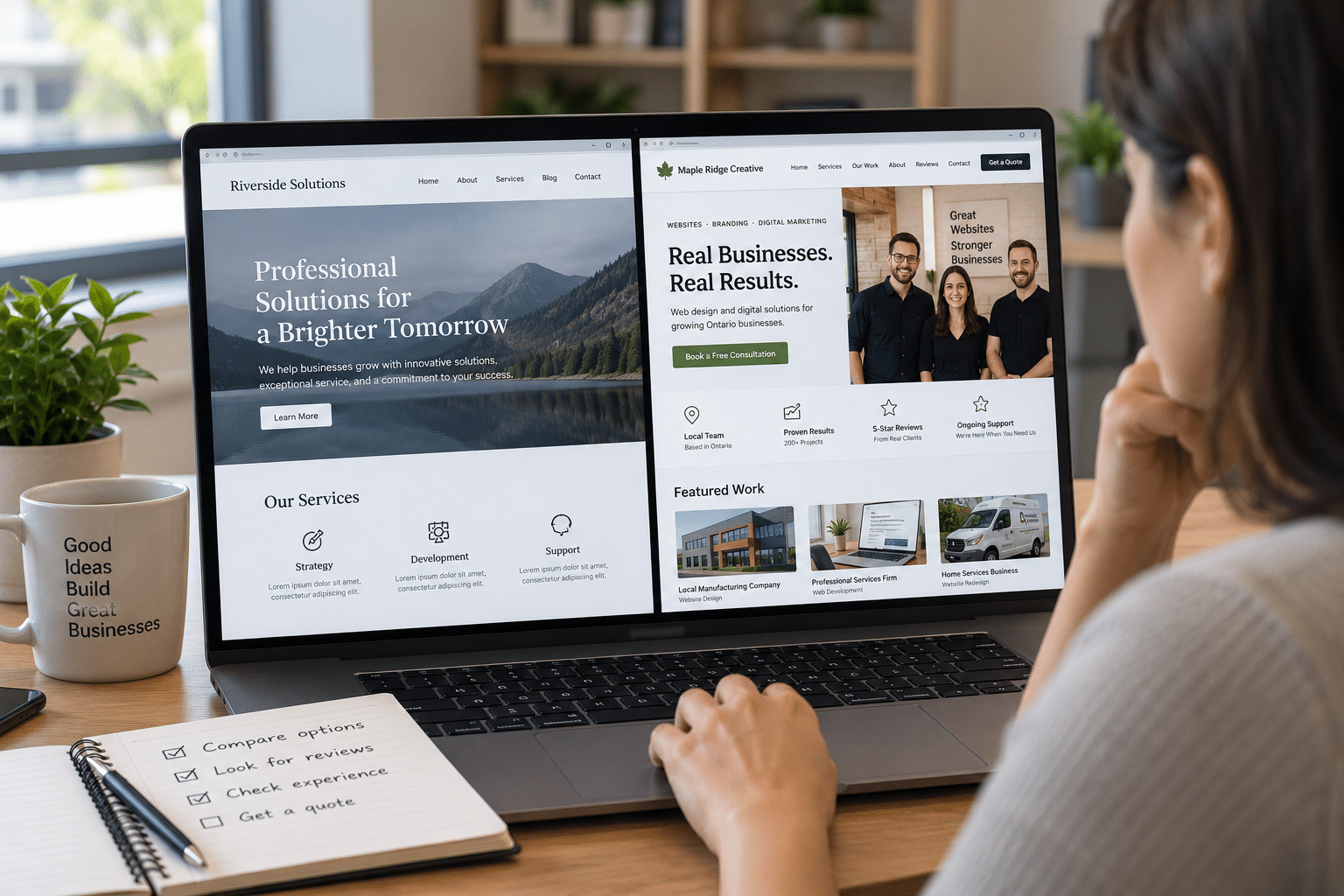
A potential customer may have five browser tabs open, each showing a different local business. Every company offers roughly the same service, serves the same area, and makes similar promises.
The customer probably does not know which company is actually better. Instead, they look for evidence that makes one choice feel safer than the others.
That is where website trust signals become important. Trust can reduce the perceived risk of contacting an unfamiliar business, and effective website design and development should help communicate that credibility while guiding the customer toward a decision.
Looking Professional Is Now the Minimum
A modern-looking website still matters. But visual polish alone does not establish that the company behind it is experienced, dependable, or suitable for the customer’s needs.
Professional-looking websites have also become widely accessible. Templates, website builders, AI tools, and inexpensive design systems give businesses of many sizes the ability to create a polished online presence.
That is not a negative development. It simply means appearance is only part of the credibility equation.
A beautiful website filled with generic photographs and broad marketing claims can still leave a visitor wondering: Who are these people, and why should I trust them?
Generic Claims Make Good Businesses Look Interchangeable
“Quality service.” “Experienced professionals.” “Customer-focused.” “Affordable solutions.” “Trusted experts.”
These claims are common because businesses want to communicate positive qualities. They may also be completely accurate.
The problem is that almost every competitor can make the same claims. When every website uses similar language, the customer has little information to help distinguish one company from another.
Imagine someone comparing several companies offering website design in Kitchener. If each company describes itself using nearly identical promises, the customer still needs another way to decide which business deserves further consideration.
Website credibility becomes stronger when a business moves from claiming credibility to demonstrating it.
Real Details Are Harder to Fake Than Marketing Language
Specificity gives visitors something they can evaluate.
Identifiable employees, actual projects, detailed services, real locations, documented experience, client examples, meaningful reviews, business history, clear geographic coverage, and explanations of how the company works can all provide useful context.
Instead of asking a visitor to accept “we are experienced,” show what that experience looks like. Explain the types of projects the company handles, who customers work with, how the process operates, and what has been accomplished.
Specificity creates evidence. A visitor can begin verifying that the business exists, understands the service, and has relevant experience with problems like theirs.
Your Photos May Be Saying More Than Your Copy
Imagery can provide another form of evidence.
Generic stock photography can make a website look polished, but the same image could often appear on a competitor’s website without changing its meaning. It communicates an idea, but it may communicate very little about the actual company.
Authentic business photography can answer questions generic imagery cannot. It can show employees, equipment, facilities, completed projects, products, offices, vehicles, or the working environment behind the business.
That does not mean stock photography automatically reduces website conversion. Authentic photography simply has the potential to communicate details about the real business that generic imagery cannot.
For a customer who has never encountered the company before, those details can make an unfamiliar business easier to understand.
Customers Look for Proof Before They Look for Promises
The stronger the marketing claim, the more useful supporting evidence becomes.
Testimonials, reviews, case studies, project examples, credentials, associations, years in business, recognizable clients where appropriate, and detailed portfolio work can all help visitors evaluate what a company says about itself.
“We deliver excellent results” asks the visitor to accept a claim. Showing relevant work and customer experiences gives the visitor evidence they can assess themselves.
This becomes particularly important when customers compare several polished businesses, such as providers of website design in Burlington. Once every option looks professional, specificity, proof, and professionalism can become more useful in narrowing the choice.
A credible website does not simply tell people what to believe about the business. It gives them information they can use to reach their own conclusion.
Small Friction Creates Big Questions
Website trust can also be affected by details that seem minor from inside the business.
Broken links, outdated information, inconsistent phone numbers, poor mobile layouts, confusing navigation, missing service details, failed forms, broken pages, old copyright dates, and unclear contact information can all introduce uncertainty.
These issues are not important because they automatically determine search rankings. They matter because potential customers experience them while evaluating the company.
A visitor may never consciously think, “If this website isn’t maintained, what else isn’t being maintained?” They may simply encounter enough friction or uncertainty to continue to another company.
That makes basic website maintenance part of the credibility experience.
The More Expensive the Decision, the More Proof Matters
Not every purchase carries the same perceived risk.
Choosing a contractor, professional service firm, healthcare provider, manufacturer, marketing agency, or major home service can involve substantial money, time, disruption, or long-term consequences. Customers considering these services have more reasons to investigate before making contact.
Someone researching a higher-value service such as website design in Oakville may therefore look beyond appearance. They may want to understand who they will work with, what experience the company has, what previous work looks like, and what happens after they make contact.
As the commitment becomes more significant, giving the customer useful evidence can help reduce uncertainty around the decision.
Your Offline Reputation Doesn’t Automatically Transfer Online
This is where established businesses can be particularly vulnerable.
A company may have decades of experience, loyal customers, skilled employees, substantial industry knowledge, and an excellent local reputation. None of those strengths automatically become obvious to someone discovering the business online for the first time.
An established company offering website design in Guelph, for example, could have extensive experience that remains almost invisible if its website contains outdated information, vague service descriptions, and little evidence of its work.
Meanwhile, another company may communicate its people, projects, process, and customer experiences more clearly.
That does not mean the competitor is the better business. It means the visitor has been given more evidence with which to evaluate it.
Your real-world credibility needs to become visible online.
Look at Your Website Like Someone Who Has Never Heard of You
Business owners naturally view their websites with information customers do not have. You already know your history, employees, reputation, expertise, and what happens when someone calls.
A stranger does not.
Review the website from that perspective. Is it immediately clear what you do and where you operate? Can visitors identify who is behind the company? Are important claims supported by evidence? Can customers see examples of your work?
Look at whether meaningful reviews or testimonials are visible, whether your experience is apparent, whether contact information is obvious, whether the website feels current, and whether the next step is clear.
Every question leads back to one larger issue: What evidence does a stranger have that choosing us is a safe decision?
The Best Website Doesn’t Always Win. The Clearest Choice Often Does.
Your competitor does not necessarily have more experience, provide better service, employ better people, or produce better work.
They may simply communicate their strengths more effectively.
A business website therefore has a larger job than looking professional. It needs to translate the company’s real-world credibility into information a potential customer can see, understand, and evaluate.
When that evidence is missing, a strong business can appear surprisingly ordinary online. When it is communicated clearly, customers have more information to decide whether the company deserves their trust and their inquiry.
If your website receives traffic but struggles to turn visitors into inquiries, request a website review to identify trust, messaging, usability, and credibility issues that may be preventing visitors from becoming inquiries.