
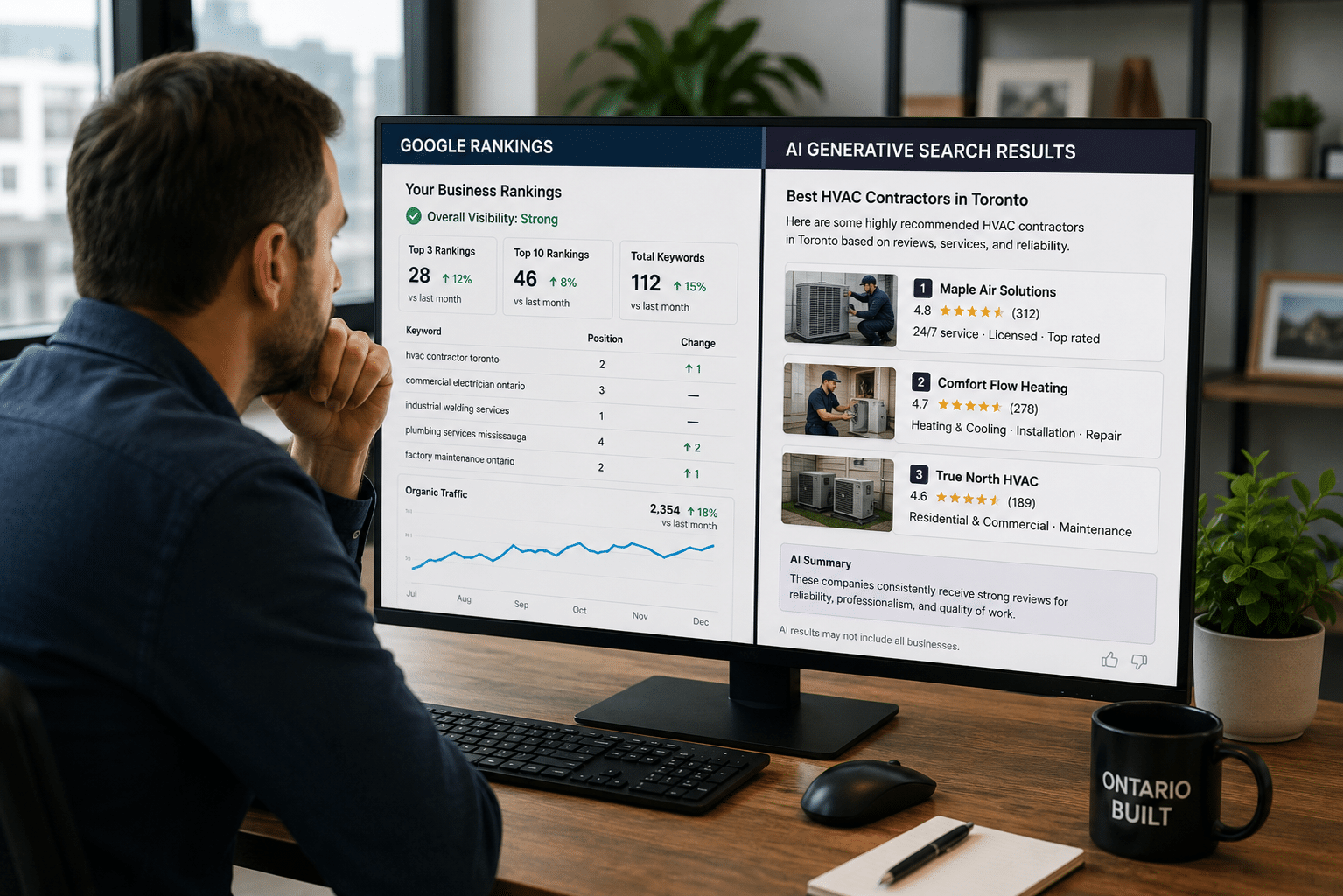
Strong Rankings No Longer Guarantee Visibility
For years, Ontario businesses measured SEO success primarily through rankings. If your company appeared near the top of Google for important search terms, visibility usually followed. That relationship is changing quickly.
AI-generated search experiences are reducing the importance of traditional blue-link rankings. Search engines increasingly summarize answers directly inside results pages, recommend businesses contextually, and generate localized suggestions without requiring users to visit multiple websites. A company can still rank well organically while losing exposure inside AI-generated recommendations.
This shift is forcing businesses to rethink what visibility actually means. Traditional rankings still matter, but they are no longer the only signal influencing discoverability. Businesses now need stronger entity recognition, structured content, and machine-readable trust indicators to support broader AI search visibility.
Many Ontario companies are beginning to invest in GEO optimization strategies because AI systems interpret websites differently from traditional ranking algorithms. Instead of simply evaluating keywords and backlinks, AI-driven search systems attempt to understand business legitimacy, expertise, geographic relevance, and consistency across the web.
Why AI Search Chooses Certain Businesses Over Others
AI search systems prioritize confidence. They look for signals that help validate whether a business is trustworthy, authoritative, and locally relevant.
Structured business information plays a major role. Clear schema markup, verified business details, accurate service-area data, and consistent online references help search systems interpret a company more reliably. Businesses investing in AI SEO optimization are focusing heavily on these machine-readable trust signals because visibility now depends on clarity as much as rankings.
Structured data is becoming especially important because AI systems rely on it to interpret relationships between services, locations, reviews, and business categories. Businesses implementing schema markup services often improve how search systems understand their offerings and geographic coverage.
Review consistency is another growing factor. AI-generated recommendations frequently rely on patterns pulled from third-party review platforms, local citations, and customer sentiment. A business with fragmented reviews, inconsistent branding, or weak reputation signals may struggle to appear prominently even with strong organic rankings.
Businesses with stronger reputation management systems often maintain better visibility because review quality, response consistency, and trust reinforcement contribute to broader credibility signals across the web.
Geographic context also matters more than many businesses realize. AI systems increasingly personalize recommendations based on proximity, service relevance, and local authority. Businesses with stronger Google Maps SEO foundations often gain advantages because location trust is easier for AI systems to validate.
Verified business information also contributes heavily to AI confidence. Inconsistent phone numbers, outdated business hours, missing categories, or incomplete listings create uncertainty for search systems. Businesses improving Google Business Profile optimization are often strengthening these legitimacy signals across multiple platforms.
The Problem With Traditional SEO-Only Strategies
Many Ontario businesses still rely on outdated SEO assumptions. Monthly ranking reports, isolated keyword targets, and thin service pages are no longer enough to support long-term visibility.
Traditional SEO still matters. Technical performance, crawlability, and site structure remain foundational parts of discoverability. A strong SEO agency strategy still contributes to indexing and search accessibility. However, rankings alone no longer guarantee recommendation visibility inside AI-generated search environments.
Businesses that depend entirely on conventional search engine optimization approaches may struggle if their strategy stops at rankings instead of broader visibility architecture.
One common issue is generic content. Many businesses publish shallow blogs that repeat similar keyword patterns without adding meaningful expertise or regional relevance. AI systems are increasingly capable of identifying weak topical authority. Businesses investing in stronger content writing services are focusing more on expertise depth, local specificity, and service clarity instead of volume-based publishing.
Weak service pages also create problems. Many contractor and local service websites use nearly identical content across cities or service categories. This limits differentiation and reduces confidence signals for AI systems attempting to evaluate expertise.
Technical clarity is becoming more important as well. AI systems rely on clean architecture, structured hierarchy, and accessible data interpretation. Businesses with weak crawl structures, duplicated pages, or inconsistent metadata may limit how effectively search systems understand their services. Strong technical SEO services help improve interpretability, indexing quality, and structural clarity.
Website experience also influences visibility indirectly. Confusing navigation, outdated layouts, and weak mobile usability reduce engagement quality and trust perception. Businesses improving website design and development often strengthen behavioral signals that support broader search credibility.
Why Ontario Businesses Are Especially Vulnerable
Ontario businesses face unusually competitive local search environments. In many industries, multiple companies offer nearly identical services across overlapping regions. Contractors, clinics, legal firms, industrial suppliers, and home service companies frequently compete within the same geographic markets using similar SEO strategies.
This creates commoditization. When websites look similar, service pages repeat the same messaging, and trust signals remain weak, AI systems have difficulty distinguishing one provider from another.
Service-area overlap also weakens visibility. Many businesses attempt to target dozens of Ontario cities without building meaningful local relevance for each location. AI systems increasingly evaluate whether a business demonstrates legitimate geographic authority instead of simply mentioning city names repeatedly.
Businesses investing in stronger local GEO-targeted landing pages are improving city-level relevance by creating more specific service coverage, local proof signals, and regional context.
Ontario markets are also highly review-driven. Consumers frequently compare businesses through ratings, maps visibility, and recommendation summaries before visiting websites directly. AI-generated search experiences amplify this behavior because recommendation systems increasingly rely on aggregated trust data instead of rankings alone.
What Businesses Must Change in 2026
Businesses adapting successfully are shifting away from isolated SEO tactics toward broader visibility systems.
This includes improving entity consistency across websites, directories, maps listings, review platforms, and business references. It also means strengthening structured content so AI systems can interpret expertise, services, and locations more clearly.
Technical clarity remains essential. Clean architecture, fast performance, crawl accessibility, and structured internal linking all support stronger interpretation across search systems.
Local proof signals are becoming equally important. Businesses should reinforce legitimacy through reviews, case studies, verified business information, and geographic relevance indicators tied to actual service coverage.
Most importantly, businesses need to view AI visibility as an operational issue rather than a marketing trend. Search behavior is evolving toward recommendation-driven discovery, and companies that adapt early will likely build stronger long-term visibility advantages.
Request an AI visibility and GEO optimization strategy review from Convex Studio.
Businesses That Adapt Early Will Compound Visibility
Businesses that adapt early are positioning themselves for stronger long-term discoverability. The companies likely to maintain visibility over the next several years will not necessarily be the ones with the highest rankings alone. They will be the businesses that communicate trust, expertise, geographic relevance, and legitimacy most clearly across the entire search ecosystem.
Ontario companies that strengthen these signals now may improve not only AI search visibility, but also overall customer confidence, conversion quality, and competitive differentiation.