
Why Generic City Pages Stopped Working
For years, many Ontario businesses relied on city landing pages to capture local search traffic. The formula was simple: create one page for each target city, add the service keyword, mention the location several times, and wait for rankings.
That approach is no longer enough.
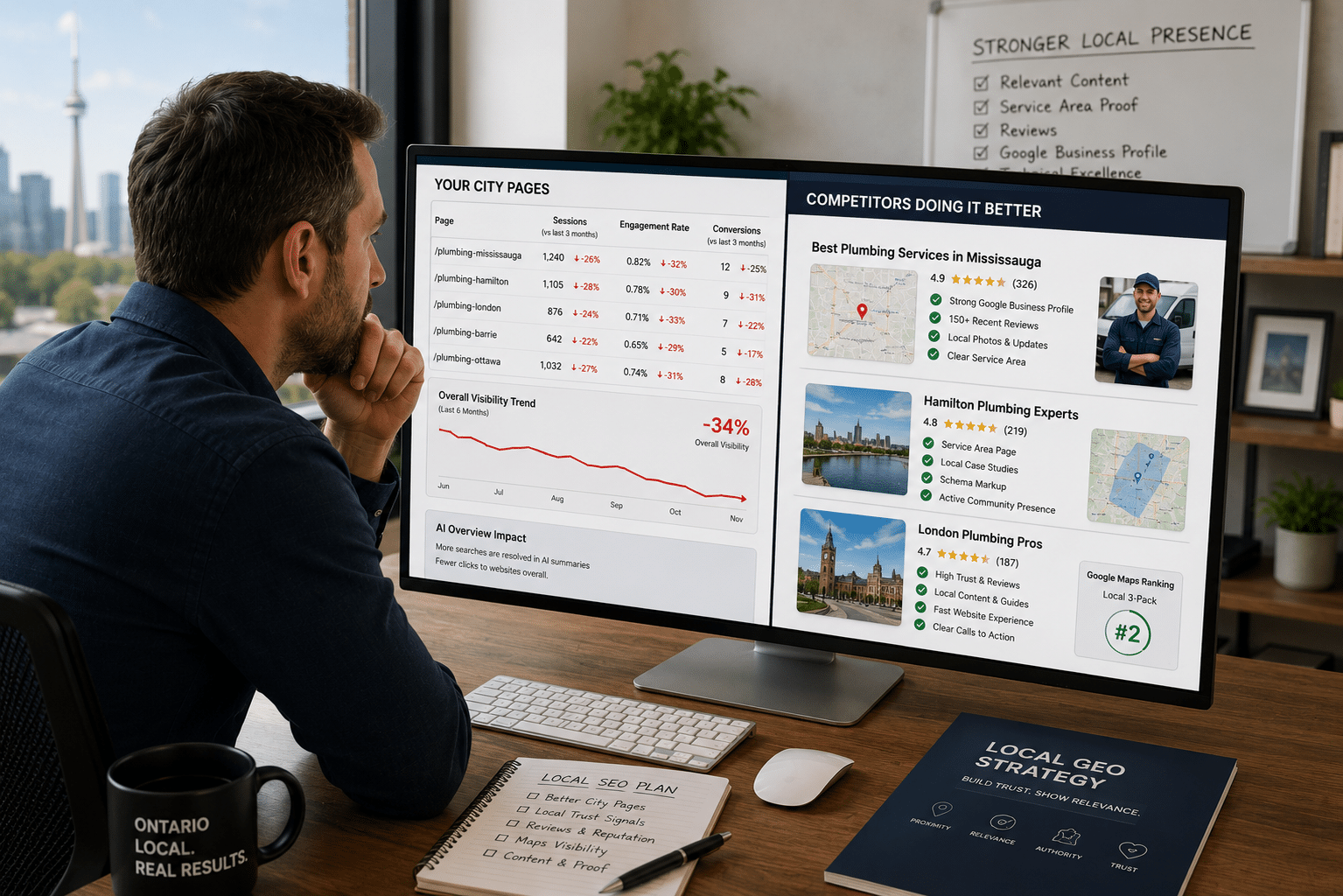
Basic “service + city” pages have become oversaturated. Contractors, clinics, home service companies, and professional firms across Ontario often publish nearly identical pages for the same regions. When every business has a page for Mississauga, Hamilton, London, Barrie, or Ottawa, the page itself stops being a meaningful differentiator.
Modern local GEO landing pages need to do more than target a keyword. They need to prove service-area relevance, support trust, connect to broader business authority, and help both users and search systems understand why the company is a credible option in that market.
Search behavior is also changing. Users increasingly receive summarized recommendations directly inside search interfaces rather than browsing multiple websites. As a result, local pages must contribute to broader business legitimacy instead of functioning as isolated keyword assets.
What Google and AI Systems Are Looking For Now
Local search is becoming more trust-driven. Traditional signals still matter, but search visibility now depends on a wider set of indicators.
A strong local page should connect clearly to the business entity behind it. That means consistent company details, accurate service-area information, verified local data, and supporting trust signals. This is where GEO optimization changes the strategy from simple keyword targeting to structured local discoverability.
AI-driven search also changes how local pages are interpreted. Systems that summarize businesses or generate local recommendations need enough information to understand legitimacy, relevance, and authority. Businesses investing in AI SEO local business strategies are focusing on clearer content, stronger trust signals, and better structured visibility.
Search systems increasingly evaluate whether businesses appear genuinely connected to the regions they target. That includes service proof, local references, engagement patterns, reviews, and geographic consistency across platforms.
Reviews, maps presence, and business profile consistency also matter. A city page may mention a location, but if the broader business ecosystem does not support that relevance, the page may not carry much weight. Strong Google Maps SEO helps reinforce proximity, trust, and local presence beyond the website itself.
Verified business data also contributes heavily to visibility confidence. Businesses improving Google Business Profile optimization often strengthen consistency between their website, maps presence, reviews, and local citations.
Structured geographic information is becoming increasingly important as well. Businesses implementing schema markup services help search systems interpret locations, service areas, and business relationships more accurately.
The Biggest Mistakes Businesses Make With Local Pages
The biggest mistake is duplication. Many businesses create dozens of city pages with the same structure, same wording, and only the city name changed. This weakens authority and gives users little reason to trust the page.
Thin content is another common issue. A page that says “we provide plumbing services in Burlington” without useful regional context, service proof, or trust indicators is unlikely to support strong visibility for long. Businesses using professional content writing services are moving away from templated filler and toward pages that explain real service relevance.
Some businesses also overstate their local presence. A company may create pages for cities where it has no real service history, no nearby proof, and no clear operational relevance. This can weaken trust with users and search systems.
Keyword stuffing remains a problem as well. Repeating the city name too often does not create authority. It often makes the page feel outdated, low quality, and less useful.
Technical structure is another overlooked issue. Large groups of poorly organized city pages can create indexing confusion, crawl inefficiencies, and duplicate content risks. Businesses improving technical SEO services are often restructuring location architecture to improve clarity and usability.
Website experience also affects local visibility performance. Weak layouts, confusing navigation, and poor mobile usability reduce engagement quality and conversion trust. Businesses investing in website design and development often improve the effectiveness of local landing pages by making them easier to navigate and more credible to users.
Traditional search engine optimization still matters, but local visibility now requires more than basic page targeting.
Why Ontario Markets Became More Competitive
Ontario local search has become crowded. Many industries now compete across overlapping service areas, especially in the GTA, Southwestern Ontario, Ottawa, Niagara, and surrounding regions.
Multi-city competition makes basic city pages less effective. A contractor in Mississauga may compete with businesses from Brampton, Toronto, Oakville, and Vaughan. A clinic in Hamilton may compete with regional providers across Burlington, Stoney Creek, and Ancaster.
This overlap creates commoditization. Many businesses use similar service messaging, similar page structures, and nearly identical local SEO tactics. AI-driven search systems are increasingly filtering for stronger trust and differentiation signals because basic location targeting no longer provides enough context.
AI-generated summaries also reduce click opportunities. When search results provide direct recommendations, fewer businesses may receive attention. That makes trust, structure, and relevance more important than simply having a page for every city.
Local reputation is becoming more influential as well. Businesses with stronger regional reviews, customer engagement, and third-party trust indicators often establish better visibility patterns over time. Companies improving reputation management are reinforcing these broader trust signals across multiple platforms.
Localized engagement outside the website also matters. Regional activity, community interaction, and localized brand visibility can support geographic authority signals. Businesses investing in a stronger social media agency strategy often reinforce local presence through ongoing regional engagement.
What Effective Local GEO Pages Actually Include
Effective local pages now function as trust and relevance hubs instead of keyword containers.
Strong pages include localized proof indicators such as regional projects, service examples, nearby customer relevance, geographic specificity, and clear operational coverage. They explain why the business genuinely serves that market instead of simply targeting the keyword.
Effective pages also connect logically into broader site architecture through internal linking, structured navigation, and related service relationships. This helps search systems understand the connection between services, locations, and business expertise.
Clear conversion structure is important as well. Local pages should help users quickly understand services, coverage areas, trust indicators, and next steps without unnecessary friction.
Most importantly, businesses need to think beyond rankings alone. Local visibility increasingly depends on how clearly a company communicates legitimacy, relevance, expertise, and geographic trust across the entire digital ecosystem.
Request a local GEO optimization review for your city and service area pages.
Businesses That Adapt Their Local Strategy Early Will Gain Ground
Businesses that modernize their local page strategy early are likely to build stronger long-term visibility advantages. Companies that continue relying on thin, repetitive city pages may struggle as AI-driven search environments prioritize trust, structure, and authority more aggressively.
Ontario businesses that strengthen geographic relevance, improve local proof signals, and create more meaningful service-area architecture are positioning themselves for better discoverability, stronger engagement, and improved competitive differentiation over time.